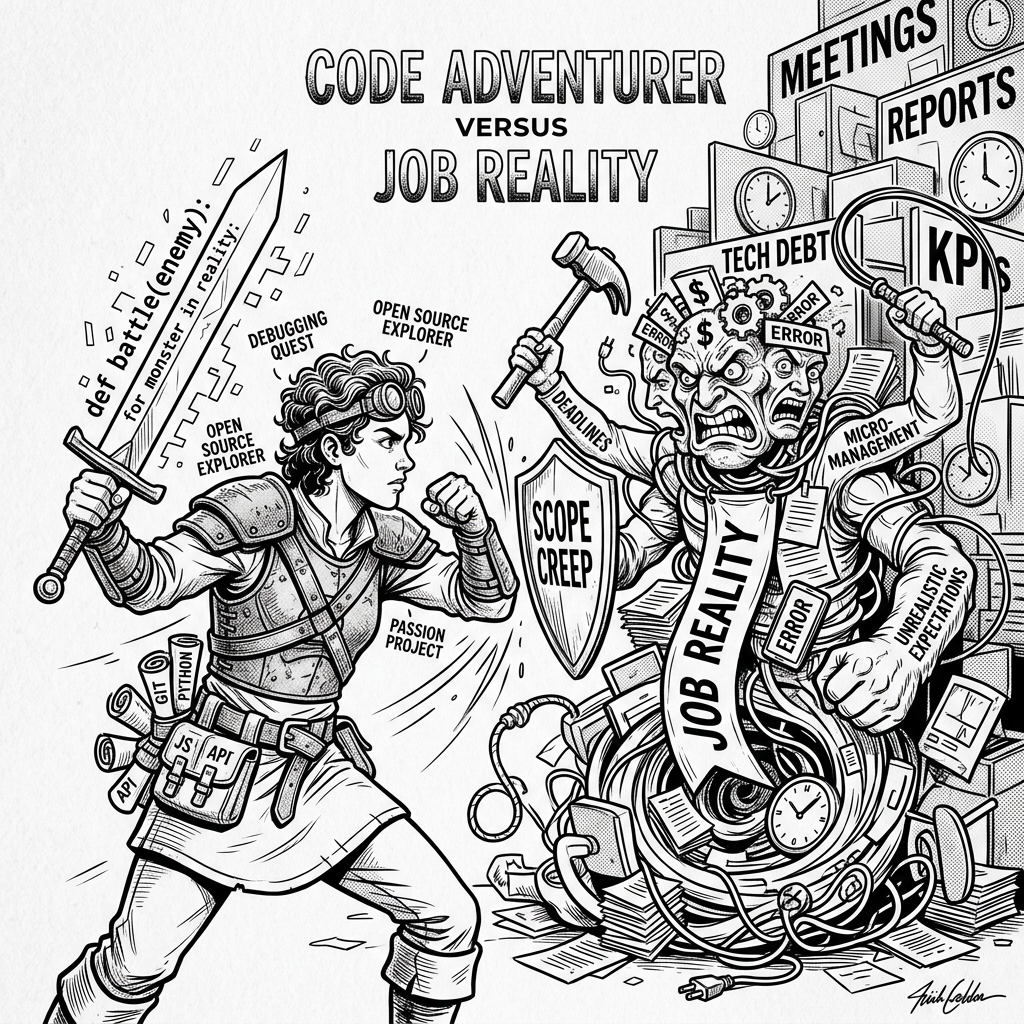
If you have just finished reading the Code Adventurer series, you have spent six episodes watching someone learn WordPress, CSS, HTML, PHP, JavaScript, and the database schema from absolute zero to a forty-eight-post blog with a custom REST API endpoint and a Gutenberg block that took three days to build. It is a good story. Parts of it are even accurate.
I work as a Technical Support Engineer at WordPress VIP, which is Automattic’s enterprise platform. I have been doing that for a few years now. Before that I was doing web development work, WordPress sites, the full stack of things the saga covers. So I have been Our Adventurer. And I have also spent years on the other side of the wall, talking to developers who are further along the journey than the saga takes you, watching what happens when WordPress meets production scale, real traffic, real edge cases, and real business stakes.
The saga gets a lot right. It also stops at exactly the point where the most interesting things start happening. This post is about both of those things.
What the Saga Gets Right
The confusion is real, and it is the process. The saga portrays the early stages of learning WordPress as genuinely disorienting, and that is accurate. The dashboard is a lot. The terminology gap between what you read and what you see on screen is real. The moment where you do not know what you do not know, and the search results return a flood of confident expertise that assumes context you do not yet have, is one of the most faithfully rendered parts of the whole series.
What I see in support every day is the after-effects of people who pushed through that confusion without fully resolving it. They built something that works, and then something breaks, and they do not have the mental model to reason about why. The saga’s insistence on actually understanding things, rather than copying and pasting until something stops producing errors, is the right instinct. It is slower. It is worth it.
The white screen of death is a rite of passage. The saga’s PHP episode covers a missing semicolon leading to eleven minutes of cold sweat and a white screen. This happens to everyone. I have seen it happen to developers with fifteen years of experience who edited something in functions.php at 11 PM on a Friday. The screen does not care about your experience level. What changes with experience is not immunity to the error. It is how fast you recover from it, and how calm you stay while you do.
What the saga does not mention is that on a live site with no local development environment, a white screen can be considerably harder to debug. The technique of adding define( 'WP_DEBUG', true ); and define( 'WP_DEBUG_LOG', true ); to wp-config.php, and then reading the debug log rather than staring at the white screen, is one of the most practically useful things a WordPress developer can learn. The saga gestures at debugging tools but the wp-config debug flags deserve their own chapter.
Hooks and filters are genuinely elegant once you understand them. The PHP episode reaches this conclusion and it is correct. The WordPress hook system, once it clicks, is one of the cleanest architectural patterns in any open-source CMS. The ability to modify behaviour at almost any point in the WordPress execution cycle without touching core files is what makes WordPress extensible in the way that it is. When I am reviewing a plugin or a customer’s custom code and I see someone who truly understands the hook system, it shows immediately. The code is structured differently. It is more predictable. It is easier to debug.
The child theme instinct is right. The saga correctly identifies that editing a parent theme directly is how you lose all your changes on the next update. What the saga does not mention is that on managed WordPress hosting, the importance of this goes up considerably. On WordPress VIP, theme updates are deployed via version control. A change made directly to a parent theme file would be overwritten on the next deployment. The child theme pattern is not just good practice. On some platforms, it is the only pattern that actually works reliably.
Security is not a feature you bolt on at the end. The saga’s security chapter, with its checklist covering 2FA, strong passwords, login URL obscuring, and backups, is solid foundational advice. The login brute force attack that arrives on a Wednesday morning and gets blocked is a genuine representation of what low-level automated attacks look like. They are constant, they are automated, and they are looking for the easiest possible target. The sites that get compromised are almost always the ones where someone skipped the basic hygiene.
What the Job Teaches You That the Saga Cannot
Scale changes everything. The saga is about building a personal blog. At personal blog scale, a slow database query costs you a few hundred milliseconds on a page load. At enterprise scale, the same query pattern run across a site with millions of posts and thousands of concurrent visitors turns into a site-wide outage. The performance chapter in the saga covers PageSpeed scores and image compression and caching. These are real and important. What the saga cannot cover is what happens when caching fails to warm properly, or when a poorly constructed WP_Query runs without an index hit and locks a table, or when a custom post type registration fires on every request including AJAX requests that have nothing to do with that post type.
These are the things I see in support tickets. Not because the developers involved are bad at their jobs. But because you cannot learn them without encountering the scale at which they become visible. A lot of what enterprise WordPress support looks like is helping smart, experienced developers understand why code that performed perfectly well at one order of magnitude starts behaving differently at the next one.
The most dangerous line of code is the one in production that nobody is watching. The saga covers the importance of backups and testing and the principle of not editing core files. What it cannot convey is the specific anxiety that comes with deploying a change to a site that is serving real users right now. The mental model shift from “I am building this” to “I am maintaining this and people depend on it” is significant. It changes how you think about every change you make. It changes how you review pull requests. It changes how you think about plugin updates.
At VIP, we review code before it goes to production. Part of that review is looking for the things that work fine in development and fail under load. Part of it is looking for security issues. Part of it is looking for the class of problem that does not produce an error, just quietly wrong behaviour that someone will notice three months later and nobody will remember the cause of. The saga’s hero learns to debug visible errors. The job teaches you to look for invisible ones.
WordPress is a platform, and platforms have opinions. The saga treats WordPress as a tool you learn to use. At a certain level of depth, WordPress becomes a platform you learn to reason about. Why does this theme behave differently in the block editor than it does on the frontend? Why does this custom query perform differently on a multisite network than on a single site installation? Why does this REST API endpoint return different results depending on whether the user is authenticated? These questions are not about WordPress being broken. They are about understanding the system well enough to predict how it will behave in conditions you have not tested yet.
The hook and filter architecture the saga covers is the beginning of this. The execution order of those hooks, and the contexts in which certain functions are and are not available, is the next layer. It does not fit in a six-episode saga. It is the thing you learn by doing the job.
The human side of support is the hardest part. The saga ends with Our Adventurer writing a post that forty-one thousand people read. The comments are open and the emails are kind. The job is different. In support, you meet people when something has gone wrong, often something that has been wrong for long enough that they are stressed about it, sometimes something that is affecting their revenue or their customers directly. The technical knowledge is necessary. The ability to communicate clearly, accurately, and calmly about something technical to someone who may not share your technical vocabulary is what actually makes the difference.
The best support engineers I know are not necessarily the most technically advanced. They are the ones who can sit with a problem, understand it fully, explain it simply, and make the person on the other side of the ticket feel like they are in capable hands. That is a skill the saga does not cover because you cannot learn it from a tutorial. You learn it from the tickets.
Where the Saga Leaves You
The saga ends with Our Adventurer at forty-eight posts, an email list of two thousand people, and a solid foundation across CSS, HTML, PHP, JavaScript, and the WordPress data model. That is genuinely impressive for a year of self-directed learning. The fictional journey is a good map of the territory.
What comes after it is harder to map. It is the territory beyond the tutorial, where the questions do not have Stack Overflow answers, where the right approach depends on context you have to develop the judgment to evaluate, where the thing you learned last year turns out to have an exception you have not encountered yet.
That is where the job lives. It is also, honestly, where it gets interesting.
The saga’s final lesson is: start, keep going, publish anyway. That is right. The job’s version of the same lesson is: ship it, watch it, learn from what breaks, and improve it. The process does not end when the first post goes live. It ends when you stop paying attention.
Do not stop paying attention.
Leave a Reply